




Please note that this post contains affiliate links and any sales made through such links will reward MageeNews.com a small commission – at no extra cost to you.
STARKVILLE, Miss.—Turkey season opens on March 15, and hunters will take to the field in search of the elusive gobbler. Most likely, they will find less of the popular game species than in previous years due to changing landscapes.
For this reason, Mississippi State University scientists and student researchers in the College of Forest Resources, in collaboration with biologists in the Mississippi Department of Wildlife, Fisheries and Parks, are tracking turkeys to better understand how they use landscapes across the state.
Guiming Wang, a professor in the MSU Forest and Wildlife Research Center’s Department of Wildlife, Fisheries and Aquaculture, wants to determine specific habitat requirements of turkeys throughout different state regions to help land managers meet the gobblers’ needs.
“In the early 1900s, turkeys were nearly extinct in the state. In the 1950s, efforts were made to restore turkey populations through reintroduction,” the study’s lead investigator said. “This effort was successful, and populations exploded in the late 1980s. Today, the wild turkeys’ return to Mississippi and much of the Southeastern United States is considered one of wildlife conservation’s greatest success stories.
“However, during the 1990s, turkey populations began to decline. That is why we need to study how differing landscapes might impact turkey movement,” Wang added.
He explained that land now has become more fragmented, with urban development and changes in use. The landscape also includes variations across the state.
“Understanding how turkeys respond to different landscapes and how they differentiate their patterns are important in land management,” Wang said. “These factors help us know if we need one management strategy for the entire state or adaptive management plans for different regions.”
For the study, scientists and biologists are trapping turkeys, equipping them with a backpack-type GPS radio tracker, and then tracking their movements.
The scientists want to determine not only how they move through the landscape, but also what types of habitat they select and how long they stay in certain areas. This data will help determine management implications.
MSU College of Forest Resources graduate student Conner Almond uses an antenna to find individual birds and then a radio receiver to identify the bird’s exact location. When close, he downloads the data from the radio tracker to determine the bird’s movement every 15 to 30 minutes.
To date, some 50 birds have been radio-collared for the study in four of the state’s five turkey management regions.
The scientists found that while hardwood forests are their preferred space, turkeys use a variety of habitats in their home ranges, including open fields for brooding, dense shrubbery for nesting, and large adjoining patches of land.
“Diverse landscapes with different forest covers in close proximity enhance wild turkey abundance,” Almond said. “Additionally, hardwood forest cover in the landscape increases wild turkey populations.”
“We found that turkey numbers peak where there is about one-third of the land type in hardwood forest. While this research is still ongoing, knowing the importance of varied habitat types and the need to have at least 29 percent hardwood forests in turkey habitat is helpful to managers as they create management plans,” Wang said.
The research also has found that turkeys generally stay within about a 10-mile radius during a year. A study using nine microsatellite DNA markers showed the maximum dispersal distance of gobblers was about 35 miles.
Wild turkey hunting generates an estimated $56 million in direct economic impact to the state, based on research conducted by natural resource economists in the Forest and Wildlife Research Center. Ensuring adequate habitat for this game bird also ensures resources for future generations.
The Forest and Wildlife Research Center at Mississippi State conducts research to expand conservation, development and usage of the forest, forest products, wildlife and fisheries resources. The center serves as the research arm for the Mississippi Department of Wildlife, Fisheries and Parks. Mississippi’s forest and forest products industries are a $12.79-billion-dollar industry. Find out more about the Forest and Wildlife Research Center at www.fwrc.msstate.edu.
MSU is Mississippi’s leading university, available online at www.msstate.edu.
-30-
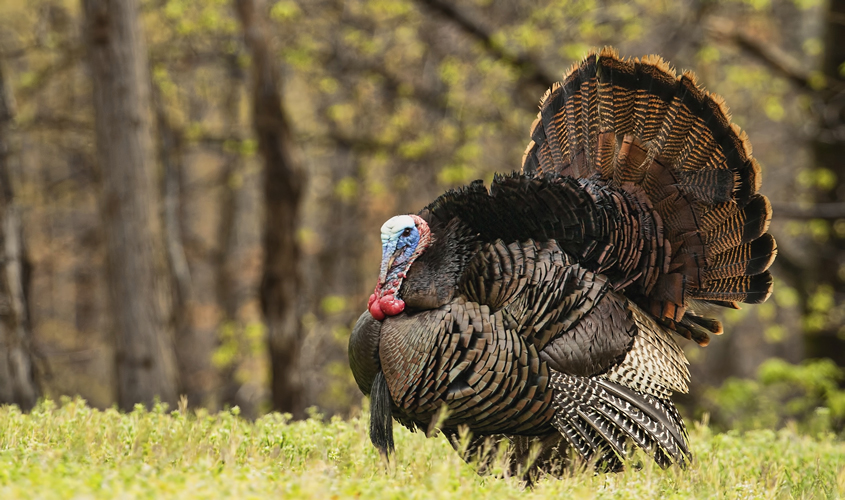
PHOTO ID: An MSU Forest and Wildlife Research Center study is tracking turkeys to better understand how they use landscapes across the state and to determine management implications. (Photo submitted)