


Please note that this post contains affiliate links and any sales made through such links will reward MageeNews.com a small commission – at no extra cost to you.

But this weekend I look forward to being blessed with the opportunity to see with my own two eyes and witness the beauty and craftsmanship
of my Creator. (And at the same time gazing at the moon and stars still makes me think of young love and romance♥)
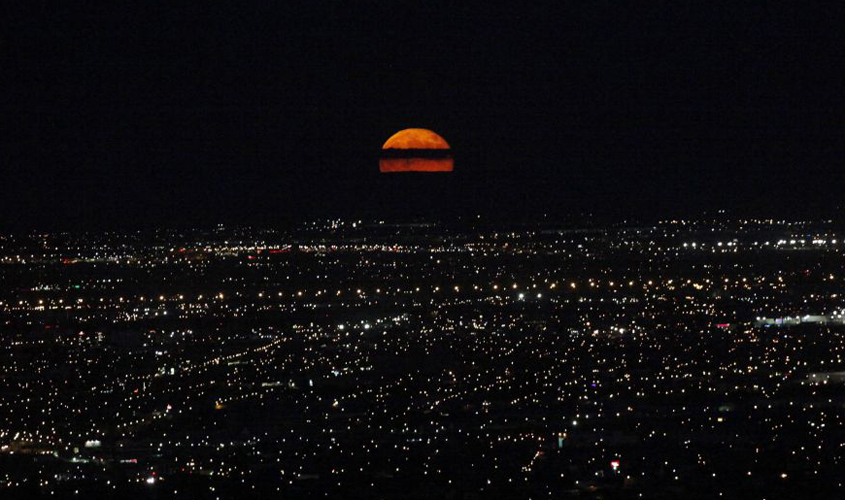
Professional and Amateur Stargazers (like myself) are in for a truly spectacular vision on Sunday when a supermoon combines with a lunar
eclipse that has not occurred since 1982. This supermoon eclipse will last for a period of time to equal 1 hour and 11 minutes, and will be
visible for viewing to both North and South America, Europe, Africa, and other parts of West Asia as well as the eastern Pacific, according to NASA.
As always, our southern Mississippi weather permitting, this supermoon will be visible near or shortly after dark, and the eclipse
will cast it into shadow beginning at 8:11 p.m. ET. The total eclipse starts at 10:11 p.m. ET, peaking at 10:47 p.m. ET.
So set you alarm on your smart phone to ensure that you don’t miss this beautiful display of God’s artistic display……
And remember Mississippi in on Central Standard Time so it will actually be an hour earlier than the Eastern Times listed above!
This is a truly a very rare phenomenon, there have only been five supermoon eclipses since 1900.
These occurred in 1910, 1928, 1946, 1964 and 1982. After this Sunday’s supermoon eclipse, the next one will not occur again until 2033.
A supermoon occurs when a new or full moon is at its closest to the Earth. “Because the orbit of the moon is not a perfect circle,
the moon is sometimes closer to the Earth than at other times during its orbit,” said Noah Petro, deputy project scientist for the
Lunar Reconnaissance Orbiter at NASA’s Goddard Space Flight Center in Greenbelt, Maryland, in a statement.
“When the moon is farthest away it’s known as apogee, and when it’s closest it’s known as perigee.
On Sept. 27, we’re going to have a perigee full moon—the closest full moon of the year.”
The space agency explains that, at perigee, the moon is about 31,000 miles closer to Earth than at apogee. This proximity
makes the moon appear 14 percent larger and 30 percent brighter in the sky than an apogee full moon, hence the term “supermoon.”
Lunar eclipses have long been a source of fascination for the human race, no matter what part of the earth they inhabit.
“Throughout human history, lunar eclipses have been viewed with awe and sometimes fear,” explained NASA, in a statement.
“Today, we know that a total lunar eclipse happens when the full moon passes through the darkest part of Earth’s shadow, the umbra.”